Buying a luxury home in Coconut Grove is one of the best decisions a Miami buyer can make. The walk-up to that decision, though, includes one conversation that catches almost every relocating buyer off guard: hurricane and flood insurance. The Florida insurance market has been through a complete reset over the past five years, and the rules here are different than in any other state in the country. The good news is that 2026 is finally bringing real relief. The better news is that with the right strategy, even a multi-million-dollar Coconut Grove home can be insured cleanly and at a defensible cost.
Why Florida's Insurance Market Is Unlike Anywhere Else
Between 2017 and 2023, Florida's homeowners insurance market went into crisis. At least seven private insurers became insolvent. Many more pulled out of the state entirely. Premiums tripled in some regions. By late 2023, more than 1.4 million Florida policyholders had been pushed onto Citizens Property Insurance Corporation, the state-run insurer of last resort.
Two pieces of legislation changed the trajectory. Senate Bill 2-A, passed in late 2022, addressed the litigation abuse that had been driving carrier losses. Senate Bill 2-D, passed in 2023, restructured reinsurance support and tightened claims handling rules. Since those reforms took effect, 17 new insurance companies have entered the Florida market.
The result is real. For 2026, Citizens has approved its first rate reduction since 2015, with an average 8.7 percent cut statewide. Miami-Dade policyholders are seeing closer to a 13.9 percent reduction. Private carriers that stayed or returned to Florida have followed with their own reductions of five to eleven percent. Reinsurance pricing, which spiked after Hurricane Ian in 2022 and Helene and Milton in 2024, has softened as actual losses came in below projections.
One detail every Florida policyholder needs to understand: Citizens carries an assessment risk that private carriers do not. If a major storm depletes Citizens reserves, the legislature can authorize an assessment of up to 15 percent on every Florida property insurance policy, even policies held with private carriers. That has never been triggered at full capacity, but it is a real piece of the calculation when comparing Citizens to a private quote.
The Three Coverages Every Coconut Grove Buyer Needs
Florida insurance is not one policy. It is at minimum three, and for most luxury buyers it is four or five.
The first is your standard homeowners policy. For a Coconut Grove buyer, this is almost always an HO-3 (the most common form) or HO-5 (broader coverage, often used for higher-value homes). HO-3 covers the dwelling on an open-perils basis and personal property on a named-perils basis. HO-5 covers both on an open-perils basis. For most homes above $3 million, HO-5 is the better fit.
The second is your wind or hurricane coverage. In Florida, wind is often included inside the homeowners policy, but it carries a separate hurricane deductible (covered below). On some policies, hurricane coverage is written as a stand-alone policy and the homeowners policy excludes wind. Read the declarations page carefully.
The third is flood insurance. This is always a separate policy. A standard homeowners policy never covers flood damage, including storm surge, which is the most expensive component of most major hurricanes. For luxury buyers in Coconut Grove, flood is non-negotiable.
Most Coconut Grove buyers also carry an umbrella liability policy (typically $5 million to $25 million of coverage) and a scheduled personal property endorsement for jewelry, art, watches, and other valuables that exceed standard sublimits.
Understanding Your Hurricane Deductible
This catches more new Florida homeowners off guard than any other line item.
Outside of Florida, deductibles are flat dollar amounts. Inside Florida, the hurricane deductible is a percentage of your dwelling coverage, not the loss amount. The common options are 2 percent, 5 percent, or 10 percent of dwelling coverage.
Here is what that means in practice. Imagine you purchase a $5 million home and insure the dwelling for $4 million (typically the rebuild cost, not the purchase price). At a 2 percent hurricane deductible, you are responsible for the first $80,000 of any hurricane-related claim. At 5 percent, that is $200,000. At 10 percent, it is $400,000.
The premium savings between deductible tiers can be significant. We have seen Coconut Grove buyers cut annual premiums by 20 to 35 percent by moving from a 2 percent to a 5 percent hurricane deductible. The right choice depends on your cash reserves and risk tolerance, not a generic recommendation.
Flood Insurance for Luxury Homes: NFIP Versus Private
The National Flood Insurance Program (NFIP) is the federal flood insurance backbone, and it caps coverage at $250,000 for the dwelling and $100,000 for contents. For a $5 million Coconut Grove home, that is wildly inadequate.
The solution is private flood insurance, which is offered by a growing number of carriers and can be written for substantially higher coverage limits. Many Coconut Grove buyers carry $1 million to $3 million in private flood coverage, often layered on top of a base NFIP policy.
Coconut Grove sits in a mix of FEMA flood zones. Waterfront streets like those in The Moorings, Bay Heights, and the Bayshore Drive area generally fall into Zone AE or VE, which are special flood hazard areas with a one percent annual chance of flooding. Interior streets at higher elevation often fall into Zone X, where flood insurance is not federally required but is still a smart purchase. Buyers can verify the exact zone for any address through the FEMA Flood Map Service Center or by calling the Miami-Dade County Flood Zone Hotline at 305.372.6466.
One important detail: Miami-Dade County has earned a Class 3 rating in the NFIP Community Rating System, which provides a 35 percent discount on NFIP flood insurance premiums for most policies issued or renewed on or after April 1, 2024. That is one of the strongest community ratings in the country.
NFIP policies have a 30-day waiting period unless purchased at closing alongside a federally-backed mortgage. Plan ahead.
Thinking about a specific street or pocket in Coconut Grove? Our Coconut Grove buyer's guide walks through flood elevation, lot orientation, and street-level detail that affects insurance and resale.
How New Construction Changes the Insurance Conversation
Florida Building Code went through a watershed change in 2002 and was strengthened again in 2012 to require more demanding hurricane protection standards. The result is that new construction in Coconut Grove insures very differently from older inventory.
Two recent Coconut Grove closings show what we mean. In April 2026, the LEED Platinum townhouse at 3119 Plaza Street closed for $1.9 million. It was built using SprayRock hurricane-resistant steel and concrete construction, with a Tesla Powerwall battery, an 11.7kW solar array for off-grid backup, and Control4 automation. That kind of resiliency package shows up directly in the wind insurance side of the policy.
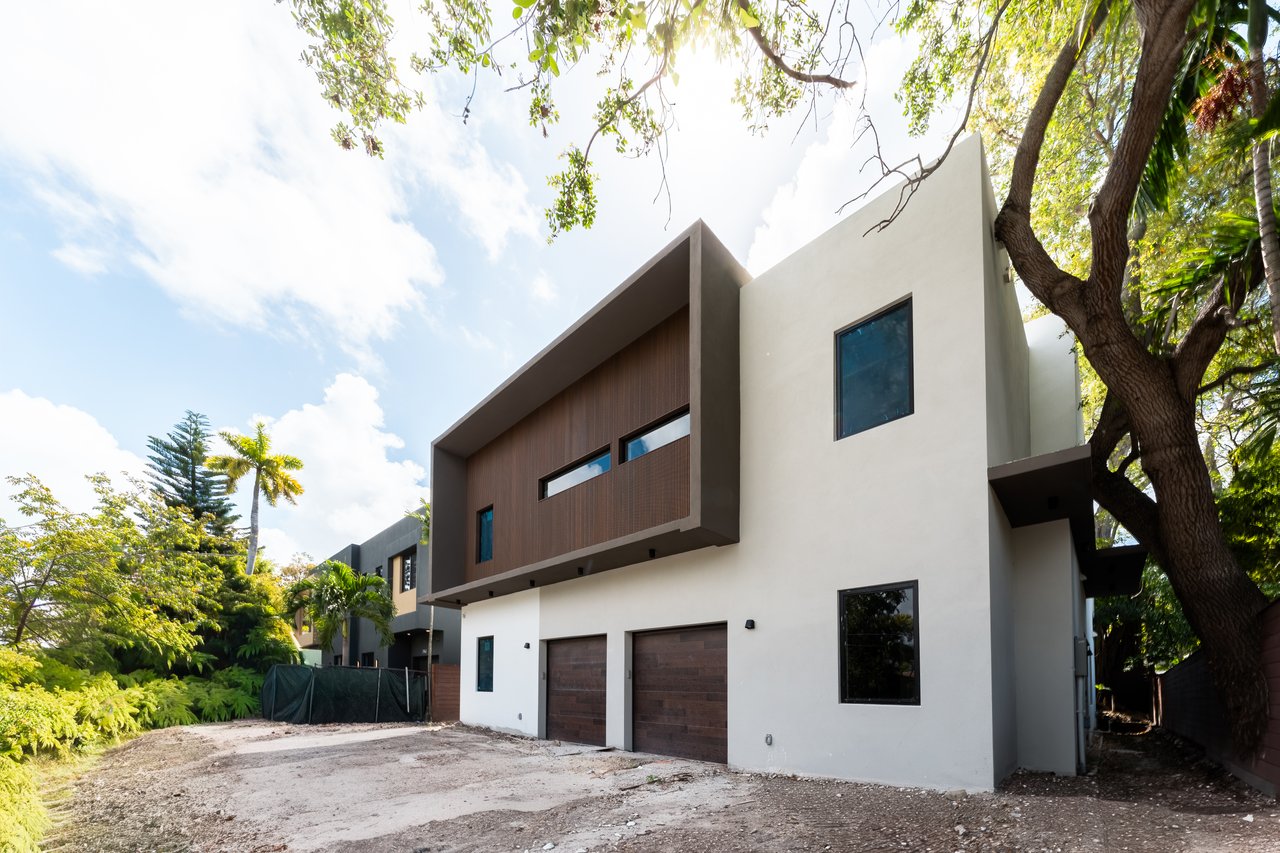
At the higher end, 4280 Ingraham Highway closed in April for $11.4 million. Designed by architect Simon Bissu and developed by Luxom Developments in 2026, it is a tropical modern estate with the full slate of modern hurricane-resistant features: impact-rated glass throughout, reinforced concrete construction, tied roof systems, and elevated mechanical equipment.
For new construction buyers, the wind mitigation discount can be substantial. Roof shape (hip is favored over gable), roof deck attachment (modern nailing patterns), opening protection (impact glass or hurricane shutters), and secondary water resistance all combine to drive premium down by 30 to 60 percent compared to comparable older homes.
Older Coconut Grove Homes Have Their Own Story
Coconut Grove is Miami's oldest neighborhood, and a meaningful share of the inventory dates from the 1920s through the 1940s. These historic homes carry real architectural value, but they need a more thoughtful insurance strategy.
For any home older than 20 years, a 4-point inspection is standard. The inspection covers four major systems: roof, electrical, plumbing, and HVAC. If any of those are aging or original, the policy will reflect that, often with sublimits or exclusions on the at-risk system.
Roof age is the single biggest factor. Most Florida insurers will not write a policy on a roof older than 15 to 20 years, or will only pay actual cash value (depreciated value) rather than full replacement cost. For Coconut Grove buyers considering an older home, planning a roof replacement before or at closing is often the smartest single move you can make.
The good news is that an older home with a new roof, impact windows, and a clean wind mitigation report can insure at premiums that are very competitive with new construction. We will cover the historic home buying process in detail later this week.
The Wind Mitigation Inspection Is the Single Most Valuable Step
If there is one report every Coconut Grove buyer should commission during due diligence, it is a wind mitigation inspection. The inspection costs $75 to $150 and stays valid for five years.
The inspector evaluates seven main areas: building code compliance, roof covering, roof deck attachment, roof-to-wall connection, roof shape, secondary water resistance, and opening protection. Each category produces a credit. On a strong report, the credits compound to as much as 30 to 60 percent off the base wind premium.
For a typical Coconut Grove home with a $15,000 annual wind premium, that can be the difference between a $5,000 annual bill and a $14,000 one. We treat the wind mitigation inspection as standard practice for every buyer we represent. We will go even deeper on the inspection process and the discounts it produces in an upcoming post.
2026 Market Update: What Is Actually Changing
The headline of 2026 is that Florida's insurance market has finally turned. For the first time in a decade, Citizens has approved a rate reduction. Private carriers are filing for cuts of their own. Seventeen new insurers have entered the Florida market since the 2022 and 2023 reforms.
What this means in practical terms: if you have been on Citizens or quoted by a single carrier in the past, get fresh quotes. Pricing in 2026 is meaningfully different from 2024, and the differences between carriers can be 30 percent or more.
Citizens has also been actively depopulating, transferring policies back to private carriers. If your Citizens policy is offered to a private carrier with rates within 20 percent of Citizens, you generally cannot refuse the transfer. That is a positive for most homeowners, because private policies do not carry the 15 percent assessment risk that Citizens does.
Reinsurance pricing has softened as actual storm losses came in below projections. That is the under-the-hood reason private carriers have room to compete on price.
Foreign and Out-of-State Buyers: Special Considerations
Buyers relocating from California, New York, or Chicago, and buyers coming from outside the United States, frequently underestimate how different Florida insurance is from their home state.
The most important practical issue is the binding restriction during named-storm events. When a tropical storm or hurricane is in the National Hurricane Center cone, most Florida carriers stop binding new coverage until the storm clears. If you are scheduled to close during hurricane season (June 1 through November 30), that creates real risk. Get your policy bound and your premium paid well before closing day.
You should also work with a Florida-licensed agent, not your existing out-of-state agent or international broker. Florida policy forms, deductible structures, and statutory requirements simply do not exist in other markets. We refer our clients to a small group of trusted Coconut Grove and Miami-area independent insurance agents who specialize in luxury coverage.
Your Pre-Closing Insurance Checklist
For every Coconut Grove buyer we represent, we walk through this checklist before going under contract:
Get quotes from at least three carriers before submitting your offer. Pull the FEMA flood zone for the exact address through the Flood Map Service Center. Order a wind mitigation inspection, even if the seller has one on file (request a fresh report). For homes built before 2005, order a 4-point inspection on the roof, electrical, plumbing, and HVAC. Confirm the hurricane deductible structure and run the math at 2, 5, and 10 percent to see the premium tradeoff. Confirm the flood policy structure, including whether NFIP alone is enough or private flood is required for adequate coverage. Look into the My Safe Florida Home grant program for hurricane upgrades you may want to make after closing. Calculate total annual insurance cost (homeowners, wind, flood, and umbrella) and add it to your monthly carrying-cost projection alongside taxes and HOA dues.
The buyers who do this work before signing a contract close cleanly. The buyers who skip it are the ones who get caught by surprise at closing.
Curious what's currently on the market with the kind of construction that insures cleanly? Browse our new construction listings or our full Coconut Grove inventory.
What This All Means for Your Coconut Grove Purchase
Insurance is not a reason to avoid Coconut Grove, and it is not a reason to avoid waterfront or older homes here. With the right structure, the right inspections, and the right carriers, even a $10 million-plus Coconut Grove estate can be insured at a defensible total annual cost.
The 2026 market is the best buying window for insurance pricing we have seen in nearly a decade. Carriers are competing again. Citizens is depopulating. Reinsurance is softening. For relocating families and luxury buyers, this is the right moment to do the work properly. We unpack the numbers behind the broader Coconut Grove market in our recent market posts.
If you are evaluating a Coconut Grove purchase or planning a sale, our team would love to walk you through the insurance side of the transaction alongside the deal itself. Reach out to the Ally and AJ Team at ONE Sotheby's International Realty at 305.744.2989, email [email protected], or contact us through allyandaj.com.